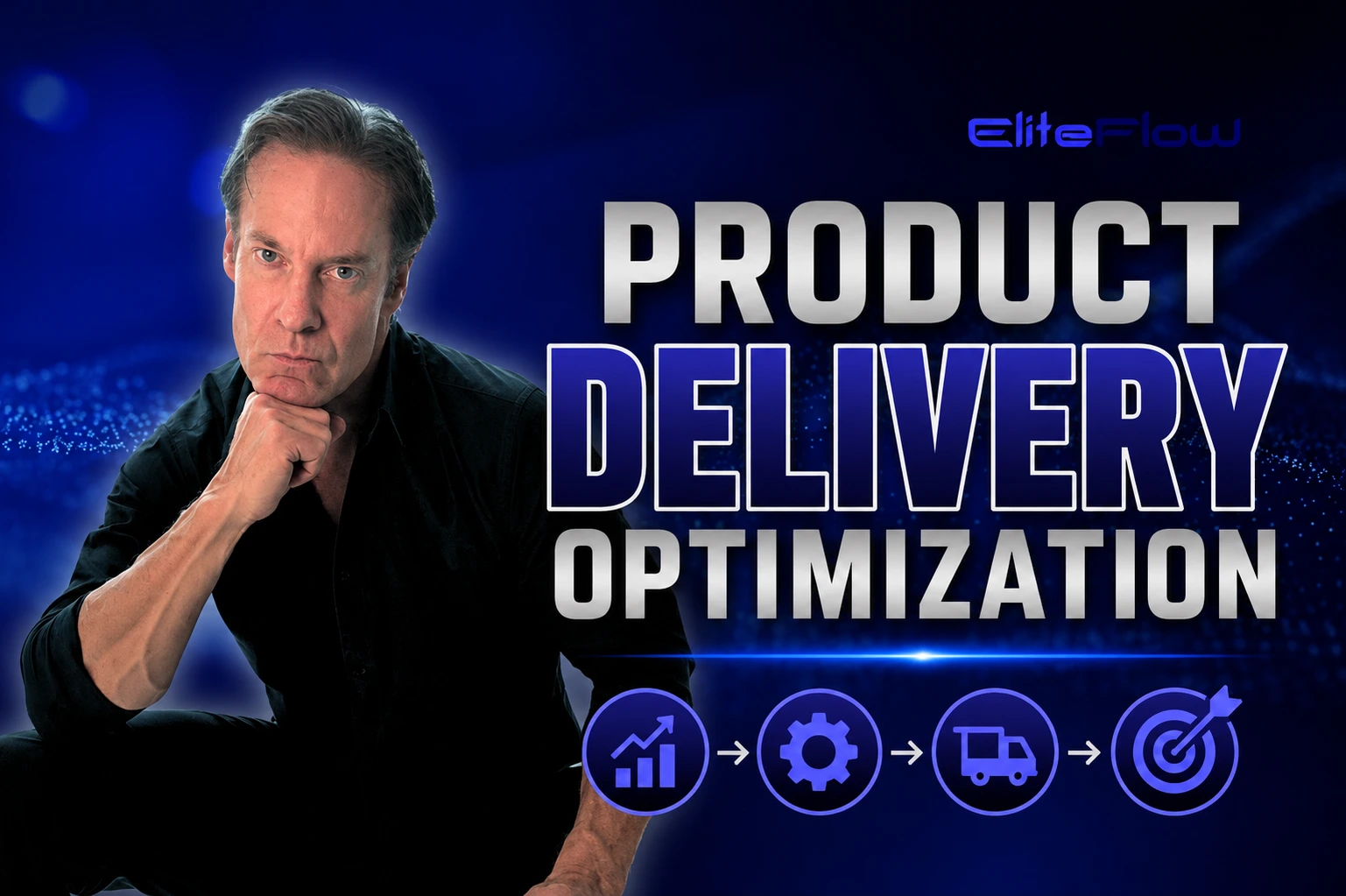
Product delivery optimization is the practice of improving how fast and reliably a product moves from idea to customer value. It treats delivery as an end-to-end system, makes the queues between teams visible, and directs investment to the constraint that actually limits how quickly products reach the market.
Key Takeaways
- Product delivery optimization spans the whole path from idea to market, not just the engineering build phase.
- The biggest delays usually sit between functions, in the handoffs across product, design, engineering, and release.
- Speed to market is a financial variable. Every week a product waits is delayed revenue and accumulating cost of delay.
- Optimization without a map rearranges effort. Digital Value Stream Mapping shows where the time is actually lost.
What is product delivery optimization?
Product delivery optimization is the practice of improving the speed, reliability, and efficiency with which a product moves from idea to delivered customer value. It treats the full path to market as a single system rather than a sequence of disconnected functions. The goal is not to make any one team faster but to make value flow through the whole stream, because the time a product spends in the market sooner is the time it spends earning rather than waiting.
Most organizations optimize the build phase and ignore the rest. Yet the longest delays usually sit upstream in prioritization and downstream in release, not in the coding itself.
Why do products stall on the way to market?
Products stall on the way to market because the work waits in the handoffs between functions, not inside any single team. A product idea waits in a backlog before it is shaped, then waits for engineering capacity, then for review, then for a release window, then for go-to-market readiness. Each handoff is a queue, and each queue adds time while adding no value. This is the invisible factory: cross-functional delay that no single team can see, because it lives in the spaces between them.
How does it differ from improving engineering speed?
Product delivery optimization addresses the entire idea-to-market system, while improving engineering speed addresses only one stage of it. Accelerating engineering when the constraint sits in product intake or release approval just feeds the next queue faster. The system can move only as fast as its tightest constraint, so the leverage is in finding that constraint wherever it lives, which is frequently outside engineering entirely. This is why optimization has to start with the whole value stream rather than the part that is easiest to measure.
How do you optimize product delivery?
You optimize product delivery by mapping the end-to-end value stream, quantifying where work waits, and directing investment to the constraint with the largest cost of delay. Digital Value Stream Mapping traces the actual path a product takes from idea to customer and separates active work from wait time, so the real targets become visible. With the map in hand, optimization becomes an economic decision: relieve the binding constraint, measure the effect, and move to the next one the system reveals.
Turning delivery speed into advantage
Product delivery optimization becomes strategic when leadership treats speed to market as a measure of how fast the organization converts ideas into revenue. EliteFlow Consulting maps the end-to-end product value stream and removes the constraints that slow it. Find out how you can boost speed to delivery by 25% using VSM.