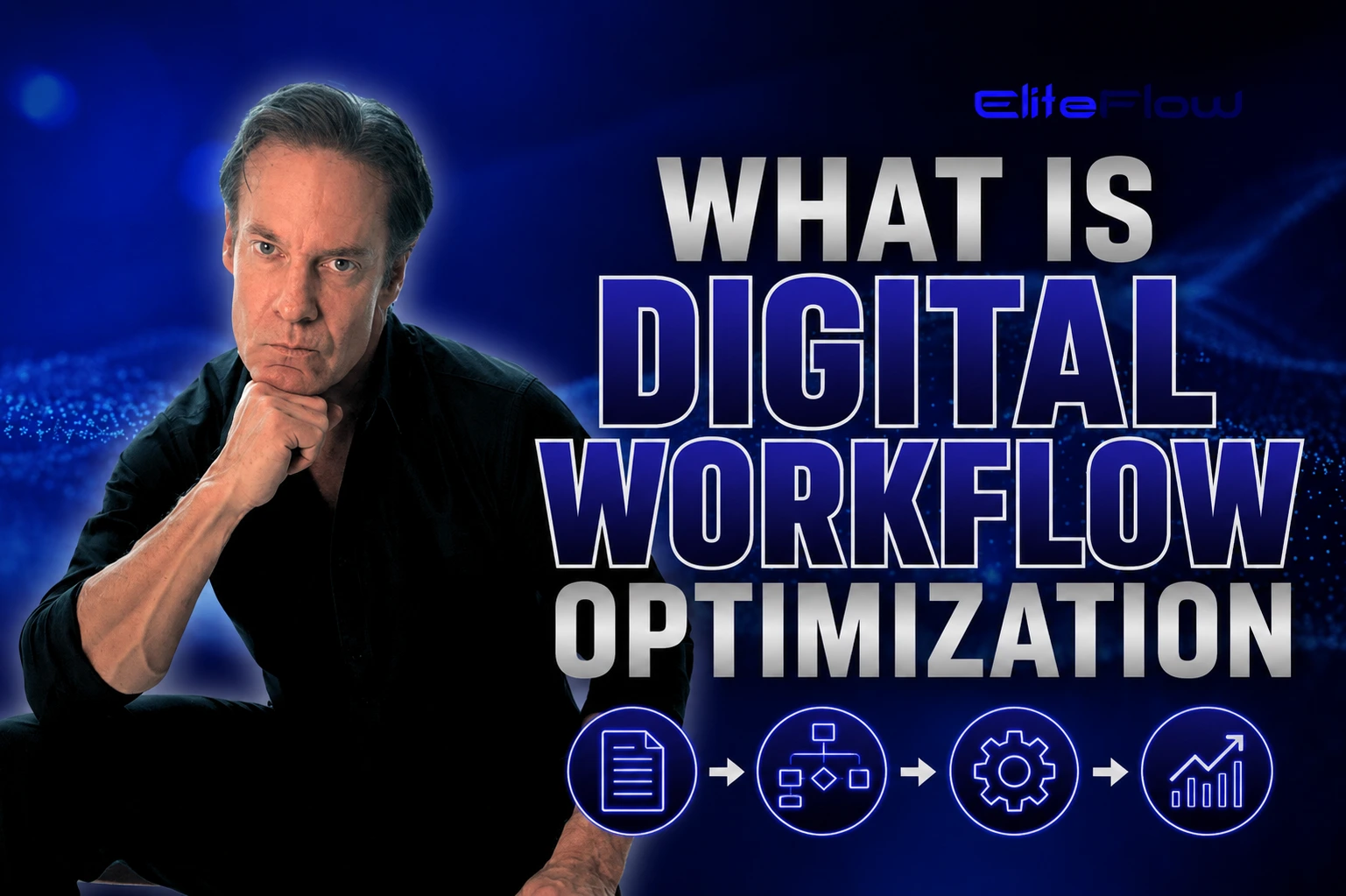
Digital workflow optimization is the systematic analysis and redesign of the handoffs, decision points, and feedback loops through which digital work moves. It eliminates accumulated waste while preserving real controls, measured against whether each step adds value or only delay across the value stream.
Key Takeaways
- Most enterprise workflows were not designed. They accumulated steps in response to incidents and audits, then never shed them.
- Optimization without a value lens just rearranges waste. Each step must justify itself against customer value.
- Workflows drift back toward waste over time, so optimization must be continuous, not a one-time project.
- The value stream view separates real optimization from cosmetic process tidying.
What is digital workflow optimization?
Digital workflow optimization is the systematic analysis and redesign of the sequences, handoffs, decision points, and feedback loops through which digital work moves. It goes beyond traditional process improvement because the workflows themselves are often partly invisible, spread across multiple tools, and governed by a mix of explicit policy and unexamined habit. Effective optimization requires mapping the actual flow of work as it occurs, not as the documentation claims, then separating the steps that create value from those that only create delay.
Why do digital workflows accumulate so much waste?
Digital workflows accumulate waste because they evolve through addition, never subtraction. Each step was added for a reason: an incident, an audit finding, a reorganization, a risk someone wanted to control. The step gets added and then stays, long after the condition that justified it has changed. Nobody is assigned to remove process, so it only ever grows. The result is that most workflows carry significant embedded waste that has become invisible through familiarity, with approval steps and handoffs persisting years after their original purpose disappeared.
How is it different from generic process improvement?
Digital workflow optimization, done through a value stream lens, forces every step to justify its existence against customer value rather than internal convenience. Generic process improvement asks how to make the existing steps run more smoothly. Value-based optimization asks a sharper question: does this step move the work toward delivering value, or does it only add delay? This distinction between value-creating and non-value-creating steps is the foundation of Digital Value Stream Mapping, and it is what prevents optimization from merely rearranging waste into a tidier configuration.
Why must it be continuous?
Digital workflow optimization must be continuous because workflows drift back toward waste through the same accumulation that created the original problem. An organization evolves, adopts new tools, reorganizes, and changes personnel, and each change quietly adds steps and handoffs. A workflow optimized twelve months ago has likely grown new waste. Treating optimization as a one-time project guarantees the gains will erode. The organizations that sustain results embed it in an ongoing value stream management practice, so drift is caught early and improvement keeps flowing to where it produces the greatest return.
Optimizing the system, not the steps
Digital workflow optimization delivers its highest return as system design rather than local efficiency tuning. Redesigning the flow so work moves with fewer queues, fewer handoffs, and fewer non-value-creating steps changes the economics of the whole system. EliteFlow Consulting maps how work actually moves and where the accumulated waste hides. Find out how you can boost speed to delivery by 25% using VSM.